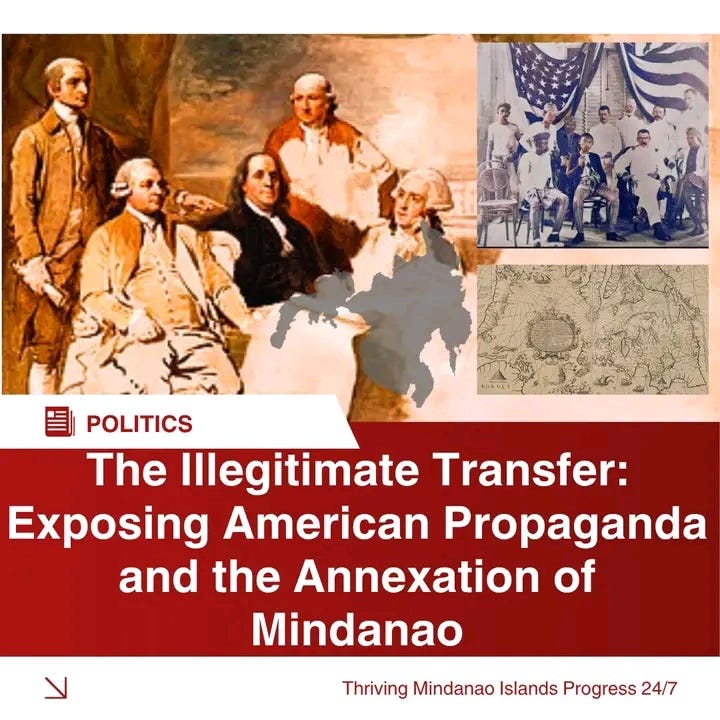
The Illegitimate Transfer: Exposing American Propaganda and the Annexation of Mindanao

The narrative surrounding the American acquisition of Mindanao at the turn of the 20th century often presents it as a straightforward consequence of the Spanish-American War and the Treaty of Paris. However, a critical examination reveals a complex history rooted in questionable legal premises, strategic ambition, and a calculated disregard for the indigenous populations of Mindanao. Far from a legitimate transfer, the American annexation of Mindanao constituted an illegal seizure, driven by resource acquisition, political control, and an imposition of Western dominance, often masked by propagandistic claims of "civilization."
The Illusion of Spanish Sovereignty in Mindanao
To understand the illegitimacy of the American annexation, one must first deconstruct the myth of comprehensive Spanish colonization in Mindanao. While Spain did maintain a presence in the Philippine archipelago for over three centuries, its effective control over Mindanao was severely limited and largely confined to coastal garrisons and missionary outposts. Historical records indicate that powerful Muslim sultanates, such as those of Sulu and Maguindanao, maintained significant autonomy and actively resisted Spanish attempts at full subjugation throughout this period .
[en.wikipedia.org](https://en.wikipedia.org/wiki/Spanish%E2%80%93Moro_conflict)[historyrise.com](https://historyrise.com/spanish-missions-in-mindanao-successes-and-failures/)[sinaunangpanahon.com](https://sinaunangpanahon.com/the-moro-province-governing-muslim-mindanao-under-american-rule-in-the-philippines/)
The Spanish-Moro conflict, lasting over 333 years, demonstrates the persistent resistance to Spanish colonial ambitions . Although Spain managed to establish some garrisons in areas like Jolo and Marawi and impose a "Government of Mindanao" by 1878, areas like Sulu often retained their customs, laws, and religion . Missionary efforts in Mindanao faced significant challenges, with strong resistance from Muslim and indigenous groups unwilling to abandon their beliefs or way of life . This indicates that, unlike Luzon and the Visayas, Mindanao was never a fully colonized or integrated Spanish territory. Therefore, any claim by Spain to cede the *entirety* of Mindanao to another power lacked a foundation of legitimate sovereignty.
[en.wikipedia.org](https://en.wikipedia.org/wiki/Spanish%E2%80%93Moro_conflict)[slideshare.net](https://www.slideshare.net/slideshow/history-report-spains-moro-policy-spanishmoro-wars-phase-1-and-phase-2/68138099)[historyrise.com](https://historyrise.com/spanish-missions-in-mindanao-successes-and-failures/)
The Treaty of Paris: A Blueprint for Illegitimate Annexation
The Treaty of Paris, signed on December 10, 1898, formally ended the Spanish-American War . Under this treaty, Spain ceded the entire Philippine archipelago to the United States for $20 million . This act transferred ownership of a vast territory and its diverse populations without their consent, including Mindanao, where Spanish control was tenuous at best . The legal validity of Spain ceding territory it did not fully control, particularly autonomous regions like those in Mindanao, is highly questionable. This transfer, effectively "selling" the Philippines, marked a new era of American imperialism .
[historyrise.com](https://historyrise.com/the-1898-treaty-of-paris-selling-the-philippines/)[en.wikipedia.org](https://en.wikipedia.org/wiki/Treaty_of_Paris_(1898))
The American government thus utilized a treaty with a waning colonial power to establish dominion over a region that had largely resisted that colonial power for centuries. This constituted an illegal annexation, as the inherent right to self-determination of the people of Mindanao was completely disregarded.
American Motives: Resources, Control, and "Civilization"
The American annexation of Mindanao was not a benevolent act but a calculated move driven by strategic and economic interests, often shrouded in the rhetoric of "civilization" and "modernization."
Economic Exploitation: Mindanao, the second-largest island in the Philippines, is rich in natural resources and fertile land . The American desire to seize control of these lands and potential mineral wealth was a significant underlying motivation for the annexation . Policies of intra-ethnic migration, implemented by the American colonial government, saw large numbers of Christian Filipino settlers from Luzon and Visayas resettled onto land tracts in Mindanao . This influx led to Christian Filipinos outnumbering indigenous Moro and Lumad populations by the 1970s, exacerbating land disputes and disrupting traditional administrative structures and control over resources .[en.wikipedia.org](https://en.wikipedia.org/wiki/Mindanao)[en.wikipedia.org](https://en.wikipedia.org/wiki/Moro_conflict)
Political and Strategic Control: The United States sought to establish a strong foothold in Southeast Asia for geopolitical influence and access to new markets. Controlling the entire Philippine archipelago, including Mindanao, was vital to this broader imperial ambition. The establishment of the Moro Province in 1903 as a distinct geopolitical region under American administration highlights this desire for direct political control .
[reconnect-recollect.com](https://www.reconnect-recollect.com/the-toolkit/glossary-of-harmful-terms/moro-rebellion/)[apps.dtic.mil](https://apps.dtic.mil/sti/tr/pdf/AD1021907.pdf)
Propaganda and the "Civilizing Mission":
To justify their aggressive expansion, American officials often deployed propaganda centering on the idea of a "civilizing mission." They claimed it was necessary to "modernize and civilize" the Moro people, portraying Moro leaders as obstacles to these efforts . This narrative served to legitimize military action and the imposition of American rule, despite its violent nature. The "Moro Rebellion" was the term used by American colonists to describe the armed resistance of the local populations against colonization, further framing indigenous resistance as illegitimate acts against a benevolent power .
[apps.dtic.mil](https://apps.dtic.mil/sti/tr/pdf/AD1021907.pdf)[reconnect-recollect.com](https://www.reconnect-recollect.com/the-toolkit/glossary-of-harmful-terms/moro-rebellion/)
The Role of Military Force and Religious Influence
The American annexation of Mindanao was solidified through brutal military campaigns, known as the Moro Wars (1902-1913), and further influenced by religious dynamics.
Military Subjugation: Upon assuming control, the United States encountered the fiercely independent Moro communities that had successfully resisted Spain . The American response was a series of violent suppressions. These campaigns involved significant American military presence and tactics that resulted in considerable loss of life among the Moro population, exemplified by incidents like the Battle of Bud Dajo in 1906, where hundreds of men, women, and children were killed by U.S. soldiers . The 14-year rebellion formally ended with the Battle of Bud Bagsak, where American forces eliminated all Moro soldiers
.[sinaunangpanahon.com](https://sinaunangpanahon.com/the-moro-province-governing-muslim-mindanao-under-american-rule-in-the-philippines/)[reconnect-recollect.com](https://www.reconnect-recollect.com/the-toolkit/glossary-of-harmful-terms/moro-rebellion/)[hearstmuseum.berkeley.edu](https://hearstmuseum.berkeley.edu/wp-content/uploads/FINAL-War-as-Resistance.pdf)
Religious and Cultural Imposition: while it'states that Roman Catholicism was influenced through military, it's important to note that the American colonial policy also assumed Christian Filipinos were more easily assimilated than the Moro population . This led to policies that favored Christians as administrators in newly defined townships, displacing Moro and Lumad individuals . Furthermore, American tactics included the privatization of communally owned land, forced conversion attempts, disarmament orders, and even the desecration of Moro corpses, actions deeply offensive to Islamic beliefs . This deliberate undermining of Moro culture and religion was a significant component of American efforts to assert control.
[reconnect-recollect.com](https://www.reconnect-recollect.com/the-toolkit/glossary-of-harmful-terms/moro-rebellion/)[en.wikipedia.org](https://en.wikipedia.org/wiki/Moro_conflict)[hearstmuseum.berkeley.edu](https://hearstmuseum.berkeley.edu/wp-content/uploads/FINAL-War-as-Resistance.pdf)
Conclusion
The American annexation of Mindanao, framed by the Treaty of Paris, stands as a testament to imperial ambition overriding principles of self-determination and legitimate sovereignty. Spain's limited and contested claim over Mindanao made its cession to the United States inherently problematic. The subsequent American actions, driven by desires for land, resources, and strategic control, and implemented through military force and cultural imposition, underscore a narrative of illegal acquisition rather than legitimate transfer. The "civilizing mission" was a propagandistic veil over policies that dispossessed indigenous populations and violently suppressed their resistance, leaving a legacy of conflict and grievance that continues to resonate in Mindanao today.