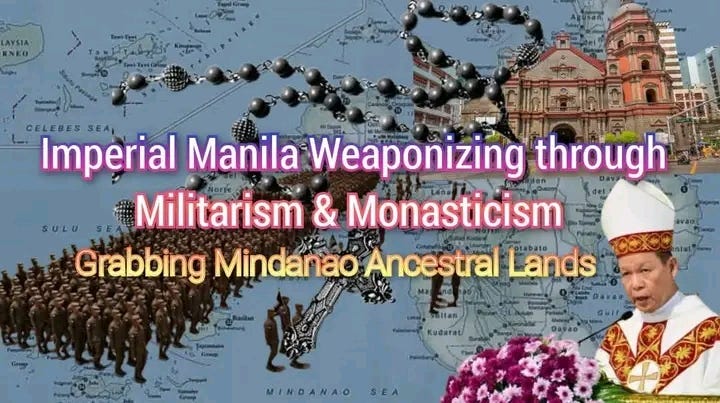
Cross and Crown: The Weaponization of Faith in the Struggle for Mindanao
The Unseen War for Ancestral Domains

In the sprawling, resource-rich island of Mindanao, a war of narratives has been waged for centuries, parallel to the armed conflicts that have defined the region. While often framed as a simple binary of Christian settlers versus Muslim or indigenous natives, a deeper, more insidious force has shaped this struggle: the weaponization of Roman Catholicism as an instrument of state policy. This is not a story of faith itself, but of its strategic deployment by what is often termed "Imperial Manila"—the centralized political and economic elite—to legitimize land grabbing, dismantle ancestral domains, and consolidate control over the Philippines' final frontier.
This delves into the historical mechanisms and contemporary echoes of how the Cross was leveraged alongside the Crown and the Constitution to facilitate one of the most significant demographic and territorial shifts in Philippine history.
I. The Historical Blueprint: Cross as Vanguard for the Crown
The modern conflict finds its roots in a colonial playbook perfected over 300 years of Spanish rule.
· Doctrina de la Descubierta (Doctrine of Discovery): The Papal Bulls of the 15th century, particularly Inter Caetera (1493), provided the theological and legal justification for European powers to claim lands inhabited by non-Christians. While its direct application in the Philippines was less formalized than in the Americas, its spirit underpinned Spanish colonial policy. Non-Christian societies were deemed to lack sovereign rights to their land, making their territories terra nullius (nobody's land) open for Christian dominion. This created a moral and legal hierarchy that privileged the Christian claim to land.
· Reducción and the Sword: The Spanish strategy of reducción—forcibly relocating indigenous populations into centralized, Christianized towns—was not merely a spiritual project. It was a tool of pacification and control. By dismantling scattered communities and severing their physical connection to ancestral lands (lupang hinirang), the colonial authorities made these vast territories "empty" and available for Spanish encomiendas (land grants) and plantations. The church, often the only institution present in remote areas, became the de facto administrator of these new settlements, mapping, baptizing, and in the process, erasing indigenous land tenure systems.
II. The American and Post-Colonial Refinement: "Civilizing" the Frontier
The Americans, and later the independent Philippine Republic, inherited and refined this framework, replacing overt religious crusading with the language of development and nationalism, yet often using the Catholic Church as a willing partner.
· The Public Land Acts (1900s): American colonial administrators implemented land laws that systematically invalidated ancestral land claims. These laws classified untitled lands as "public," ignoring the complex, customary ownership systems of the indigenous peoples and the Moro Muslims. To own land, one had to apply for a Torrens title—a process that required documentation, literacy, and connections that indigenous communities largely lacked. This legalistic land grabbing was often justified under the guise of bringing "civilization" and "order" to a "lawless" frontier, a narrative the established Church often implicitly endorsed.
· Settlement as National Policy: The most potent weaponization of Catholicism came with the post-WWII policy of state-sponsored migration. Programs like the National Land Settlement Administration (NLSA) and later, the massive resettlement efforts under President Magsaysay, actively encouraged landless peasants from the Visayas and Luzon (overwhelmingly Catholic) to migrate to Mindanao.
· The "Land of Promise" Narrative: Mindanao was marketed as a "Land of Promise" (Lupang Pangako), a fertile frontier for hardworking, God-fearing Christians. This narrative, often supported by Church homilies and community networks, framed migration as a patriotic and divinely-sanctioned endeavor.
· Demographic Re-engineering: The result was a dramatic demographic shift. In the early 1900s, Moro Muslims and indigenous peoples constituted the vast majority of Mindanao's population. Today, they are minorities in their own homeland. This influx created immediate and violent land conflicts, as settlers, backed by state-issued titles, fenced off lands that indigenous communities had stewarded for generations.
III. The Mechanisms of Weaponization: How It Worked On The Ground
The process was not accidental but systematic, involving a confluence of state and Church interests.
1. Moral Legitimation: The Church provided a moral cover for displacement. The narrative painted Catholic settlers as pioneers taming a wilderness, while framing the resistance of Moro Muslim and indigenous peoples' communities as backwardness or banditry. Their spiritual "otherness" (being Muslim or animist) made their claims to land seem less legitimate in the eyes of the Catholic majority and the state.
2. Institutional Presence: The Catholic Church, through its network of parishes, schools, and NGOs, was often the first and most stable institution in new settlement areas. It acted as a community anchor, reinforcing the settlers' cultural and religious identity and creating a parallel authority to the state, which further marginalized the native populations.
3. Direct Land Ownership: Ironically, the Church itself became a major landowner in Mindanao. Vast tracts of land were acquired through donations, purchases, or historical claims, some of which are contested by ancestral domain claimants. The management of these "Church lands" has, at times, put it in direct conflict with indigenous peoples.
4. Silence and Complicity: During the most aggressive periods of land grabbing and conflict, the institutional Church's voice was often muted. While there were courageous individual priests and religious who stood with the oppressed (e.g., the Society of the Divine Word in some indigenous peoples' areas), the hierarchy's failure to consistently and forcefully condemn the state's displacement policies was seen as complicity. This silence was weaponized by the state to proceed with minimal moral opposition.
IV. Contemporary Echoes and Indigenous Resistance
The legacy of this history is starkly visible today.
· Agribusiness and Displacement: The current wave of land grabbing is led by corporate agribusiness plantations (for bananas, pineapples, and palm oil). These corporations often secure leases on land classified as "public" or through agreements with a few individuals, bypassing the Free, Prior, and Informed Consent (FPIC) required by the Indigenous Peoples' Rights Act (IPRA). The historical marginalization of these communities makes them vulnerable to these modern incarnations of land grabbing.
· Indigenous Peoples and the Struggle for Education: The indigenous peoples' establishment of their own schools is a direct response to this historical erasure. These schools teach children about their culture, history, and rights to their ancestral domain. The state's frequent red-tagging and militarization of these schools is a continuation of the old narrative: that indigenous self-determination is a threat to national security.
· The Bangsamoro Autonomous Region (BARMM): The creation of the BARMM is the Moro Muslim people's monumental achievement in reclaiming their political right to self-governance, a direct challenge to centuries of centralized control from Manila. It represents a partial decolonization of the state structure in Mindanao.
Reckoning with a Loaded Legacy
The weaponization of Roman Catholicism in Mindanao is a profound and painful chapter in Philippine history. It demonstrates how faith, when entangled with state power and economic ambition, can be perverted into a tool of dispossession. The Cross was not merely carried by settlers; it was strategically deployed ahead of them to sanctify their claim and invalidate those of the native inhabitants.
Addressing the current conflicts in Mindanao requires a honest reckoning with this past. It demands a deconstruction of the "Imperial Manila" mindset that still views the region as a resource colony. It also calls for a more critical and self-reflective role from the Catholic Church, one that moves beyond charity to actively championing land justice and the right to self-determination for the indigenous peoples and Moro Muslims of Mindanao—a true act of faith-based justice that could begin to heal the deep wounds inflicted by centuries of weaponized belief.
References & Further Reading (Reliable Sources):
1. Abinales, Patricio N., and Donna J. Amoroso. State and Society in the Philippines. Rowman & Littlefield Publishers, 2005. (Provides essential context on state formation and Mindanao policy).
2. Gowing, Peter G. Mandate in Moroland: The American Government of Muslim Filipinos, 1899-1920. Philippine Center for Advanced Studies, 1977. (A classic on American colonial policy in Muslim Mindanao).
3. McKenna, Thomas M. Muslim Rulers and Rebels: Everyday Politics and Armed Separatism in the Southern Philippines. University of California Press, 1998. (An anthropological masterwork on the roots of Moro resistance).
4. Rodil, B. R. The Minoritization of the Indigenous Communities of Mindanao and the Sulu Archipelago. Alternate Forum for Research in Mindanao, 1994. (A crucial work by a Mindanaoan scholar detailing the process of demographic and political marginalization).
5. The Philippine Commission on Human Rights (CHR) and The International Work Group for Indigenous Affairs (IWGIA). Various reports on land rights and human rights violations against indigenous peoples and Moro Muslim communities.
6. Official Documents: The Indigenous Peoples' Rights Act (IPRA) of 1997 (Republic Act 8371) and the Bangsamoro Organic Law (BOL) are primary legal texts that represent attempts to rectify historical injustices.
#tmipumedia #substack